
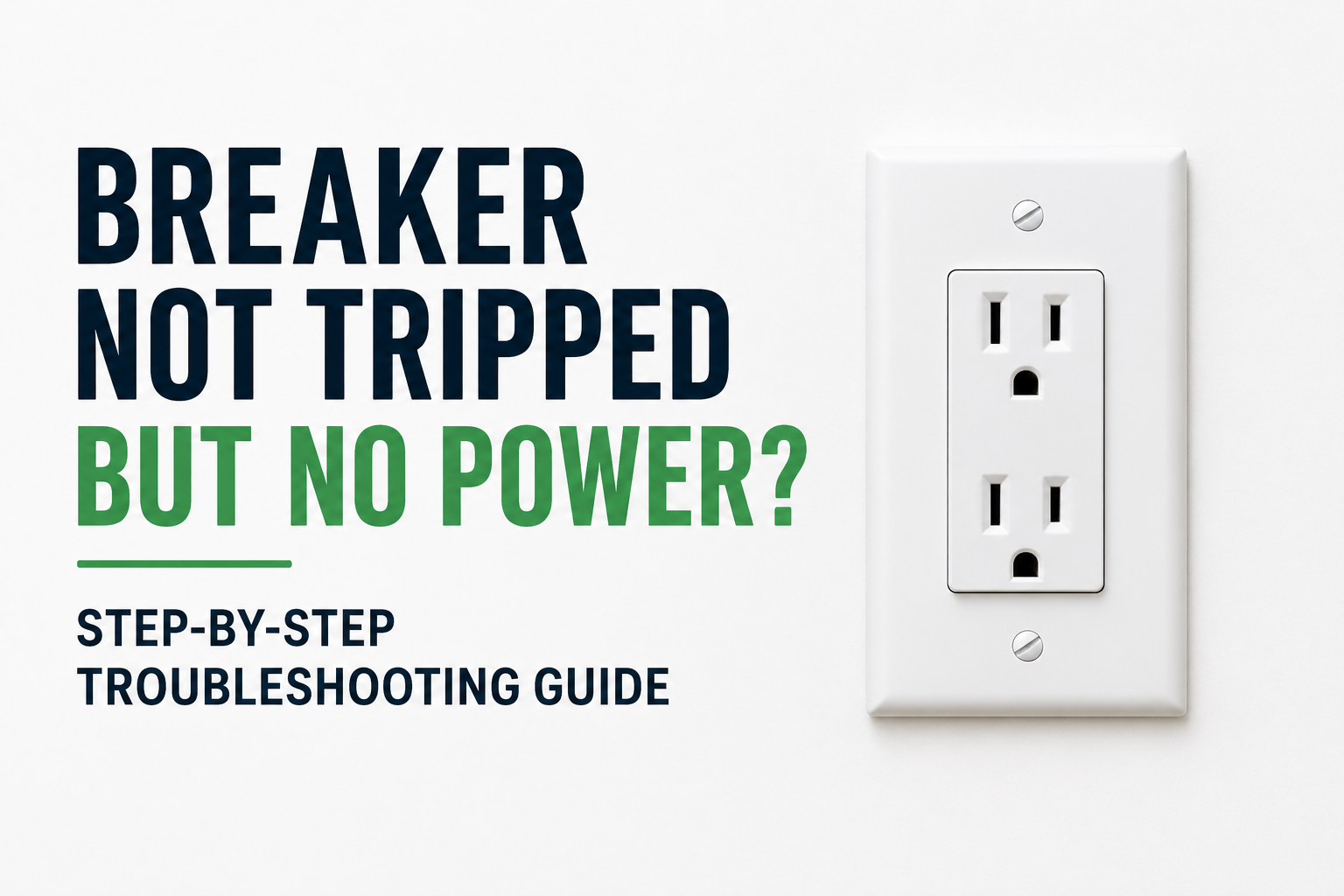
You flip the switch, plug something in… and nothing happens. No power. But when you check your electrical panel, the breaker isn’t tripped.
This is one of the most confusing electrical problems homeowners face — and in some cases, it can also be dangerous.
The short answer: if your breaker is not tripped but you have no power, the issue is usually caused by a loose connection, a failed outlet, a hidden GFCI, or a problem inside your electrical panel.
This guide will walk you through exactly how to diagnose the issue step by step — and help you understand when it’s safe to fix yourself and when it’s time to call a professional.
If you’re dealing with a time-sensitive issue, you can also reach out directly through our contact page or explore our full electrical repair services.
Most Common Reasons You Have No Power (Even When the Breaker Is On)
Before jumping into troubleshooting, it helps to understand what’s actually happening behind the scenes.
Electrical failures usually come down to three root causes:
- Bad connection
- Damaged wiring
- Failed component (outlet, breaker, or device)
Here are the most common scenarios homeowners run into:
- Loose wire connection — often inside an outlet or junction box
- Tripped GFCI outlet — even if it’s in another room
- Burnt or failed outlet — especially with older wiring
- Breaker failure — the breaker looks ON but isn’t delivering power
- Partial power issue — sometimes related to panel or utility problems
If you’re noticing additional symptoms like flickering lights, that could point to a deeper issue — learn more here: flickering lights causes and when to worry.
Recent Posts
- Why Won’t My Circuit Breaker Reset? 7 Causes Homeowners Should Check First
- Why Is My GFCI Outlet Not Working? 7 Common Causes & Quick Fixes
- How to Tell If an Electrical Circuit Is Overloaded
- Outlet Stopped Working but the Breaker Isn’t Tripped? 7 Common Causes
- Why Is My Ceiling Light Flickering? Common Causes & Warning Signs
BREAKER NOT TRIPPED BUT NO POWER? DON’T WAIT.
If you have no power but your breaker is still on, the issue could be a loose connection, failed outlet, or hidden GFCI.
Our licensed electricians in the Seattle area can quickly diagnose and restore power safely.
Schedule an ElectricianStep-by-Step Troubleshooting Guide
Follow these steps in order. This helps you isolate the issue quickly without guessing.
- Check if it’s one room or multiple areas
If only one room is affected, the issue is likely local (outlet, wiring, or GFCI). If multiple areas are affected, it may be a panel or circuit issue.
- Reset the breaker properly
Turn the breaker fully OFF, then back ON. Sometimes breakers don’t visibly trip.
- Look for tripped GFCI outlets
Check bathrooms, kitchen, garage, and exterior outlets. One tripped GFCI can shut down multiple outlets.
- Test other outlets on the same wall
If multiple outlets are dead, you may have a loose connection upstream.
- Check for signs of damage
- Burning smell
- Warm outlets
- Buzzing sounds
If your issue looks similar to a full or partial outage, you may want to review this guide: power outage vs electrical problem.
When the Problem Is the Outlet (Most Common Scenario)
In many cases, the breaker is fine — and the problem is actually at the outlet level.
This can happen due to wear, poor installation, or overloaded connections.
Here’s how to identify outlet-related issues:
| Symptom | Likely Cause |
|---|---|
| One outlet not working | Failed outlet or loose wire |
| Multiple outlets dead | Upstream connection issue |
| Sparks when plugging in | Worn or damaged outlet |
If you’ve seen sparking or unusual behavior, check this guide: why outlets spark.
For direct service, visit our outlet repair service page.
Hidden GFCI Outlets That Shut Off Power
One of the most overlooked causes of power loss is a tripped GFCI outlet — especially one you didn’t even know existed.
GFCIs are commonly installed in:
- Bathrooms
- Kitchens
- Garages
- Outdoor areas
What many homeowners don’t realize is that one GFCI can control multiple outlets — even in different rooms.
If your outlets suddenly stopped working, this is one of the first things to check.
Learn more here: GFCI outlet troubleshooting guide.

NO POWER BUT BREAKER NOT TRIPPED? COULD IT BE AN ELECTRICAL ISSUE?
Several outlets stopped working? An outlet not working but the breaker is still on? Lights flickering or power out in part of the house? These are common signs of loose wiring, failed outlets, tripped GFCI protection, or deeper electrical problems that shouldn’t be ignored.
If you’re in the greater Seattle or Puget Sound area, call, text, or request service online — our licensed electricians can quickly diagnose and safely restore power.
Warning Signs This Is a Serious Electrical Issue
Not all “no power” situations are harmless. Some indicate real electrical hazards.
Call an electrician immediately if you notice:
- Burning smell from outlet or panel
- Flickering or dimming lights before power loss
- Buzzing or crackling sounds
- Warm or discolored outlets
These symptoms often point to overheating or failing connections.
Read more here: burning smell from outlet or panel.
If you're unsure whether your situation is urgent, check: is this an electrical emergency?
When the Problem Is the Breaker or Electrical Panel
Sometimes the breaker itself is the issue — even if it looks like it’s ON.
Breakers can fail internally and stop delivering power without tripping.
Other panel-related issues include:
- Worn breaker connections
- Overloaded circuits
- Damaged bus bars
If your home is older or you’ve had repeated electrical issues, it may be time to consider a panel upgrade.
Learn more here: electrical panel upgrades or read why homeowners upgrade panels.
When to Call a Professional Electrician
If basic troubleshooting doesn’t restore power, it’s time to bring in a professional.
You should call an electrician if:
- The issue keeps coming back
- You suspect wiring problems
- There are signs of overheating or damage
- Multiple rooms or circuits are affected
Electrical issues can escalate quickly — and guessing can make things worse.
Our team provides fast, code-compliant diagnostics and repairs. Explore our emergency electrician services or view all electrical services.
You can also check reviews from local homeowners here: customer reviews.
Need an Electrician in the Seattle Area?
If you’re in Bellevue, Renton, Kent, Sammamish, Issaquah, or nearby, our licensed electricians can help with repairs, upgrades, and installations.
Explore our services and areas below or call for fast, local service.
Need an Electrician? We Can Help.
From small repairs to full system upgrades, our licensed electricians are ready to help. Fast response. Quality work. Guaranteed.
Available 7 Days a Week
Services We Offer
Professional electrical services for your home or business.
Electrical Repairs
Troubleshooting, repairs, and safety inspections.
Panel Upgrades
Upgrade your panel for more power and safety.
EV Charger Installation
Fast, safe installation for all major EV brands.
Dedicated Circuits
Add power for appliances, EVs, hot tubs, and more.
Lighting Installation
Indoor, outdoor, recessed, accent and more.
Areas We Serve
Proudly serving the Eastside and South King County.
Licensed. Insured. Local.
We're a local team you can count on for safe, code-compliant work.
Proudly Serving the Greater Seattle Area
Whether you're in a quiet cul-de-sac in Sammamish or a busy neighborhood in Tacoma, Surge Electrical delivers expert, licensed service you can count on. We cover a wide service area to bring fast response times, transparent pricing, and trustworthy workmanship to homes and businesses across the region.
- Seattle, WA
- West Seattle, WA
- Bellevue, WA
- Redmond, WA
- Kirkland, WA
- Issaquah, WA
- Sammamish, WA
- Renton, WA
- Newcastle, WA
- Mercer Island, WA
- Maple Valley, WA
- Kent, WA
- Covington, WA
- North Bend, WA
- SeaTac WA
- Tukwila, WA
- White Center, WA
Additional Service Areas
- Algona, WA
- Auburn, WA
- Ballard, WA
- Ballinger, WA
- Beacon Hill, WA
- Belltown, WA
- Boradview, WA
- Bothell, WA
- Browns Point, WA
- Burien, WA
- Capitol Hill, WA
- Carnation, WA
- Clyde Hill, WA
- Cottage Lake, WA
- Dash Point, WA
- Delridge, WA
- Des Moines, WA
- Duval, WA
- East Renton Highlands, WA
- Eastgate, WA
- Fairwood, WA
- Federal Way, WA
- Forest Villa, WA
- Fremont, WA
- George Town, WA
- Green Lake, WA
- Greenwood, WA
- Haller Lake, WA
- Inglewood, WA
- Juanita, WA
- Klahanie, WA
- Lake City, WA
- Lake Forest Park, WA
- Leschi, WA
- Madison Park, WA
- Madison Valley, WA
- Madrona, WA
- Magnolia, WA
- Maple Leaf, WA
- Medina, WA
- Moorlands, WA
- Muckleshoot, WA
- North City, WA
- Northgate, WA
- Pacific, WA
- Phinney Ridge, WA
- Pine Lake, WA
- Queen Anne, WA
- Rainier Valley, WA
- Redmond Ridge East, WA
- Ridgecrest, WA
- Richmond Beach, WA
- Shoreline, WA
- Snoqualmie, WA
- Trilogy, WA
- Trossachs, WA
- Univercity District, WA
- Union Hill-Novelty Hill, WA
- Washington Park, WA
- Woodinville, WA
Frequently Asked Questions
If you have no power but the breaker is not tripped, the issue is usually caused by a loose wiring connection, a failed outlet, a tripped GFCI outlet, or a bad breaker that is no longer delivering power. Breakers only trip during overloads or short circuits, so many wiring failures can occur without tripping the breaker.
Yes, a breaker can fail internally and stop supplying power even if it appears to be in the ON position. This can happen due to wear, overheating, or internal damage. If resetting the breaker does not restore power, the breaker or panel may need professional inspection.
Outlets may stop working even when the breaker is fine due to a tripped GFCI outlet, a loose connection inside an outlet box, or a failed outlet upstream in the circuit. Since multiple outlets are often wired together, one failure can interrupt power to several outlets.
Start by turning the breaker fully OFF and back ON. Then check for tripped GFCI outlets in bathrooms, kitchens, or garages. Test nearby outlets to see if multiple are affected. If the issue persists, the problem may involve loose wiring or a damaged outlet that requires professional repair.
It can be dangerous, especially if the power loss is caused by a loose or overheating connection. Warning signs include burning smells, buzzing sounds, or warm outlets. In these cases, you should stop using the circuit and have it inspected by a licensed electrician immediately.
No Power but Breaker Not Tripped? Don’t Ignore the Signs
If you’re dealing with a situation where your breaker is not tripped but you still have no power, it’s usually a sign that something deeper is happening within your electrical system. While it may seem like a minor inconvenience at first, issues like loose wiring, failing outlets, hidden GFCI interruptions, or even a faulty breaker can all cause power loss without ever tripping the breaker. These types of problems often develop over time and can quickly turn into safety hazards if left unresolved.
Many homeowners first notice this issue as a dead outlet, multiple outlets not working, or even power out in one room but the breaker is still on. In some cases, it can escalate into partial power loss or more serious electrical failures. If your situation is starting to look like a larger issue, you may want to review related guides like outlets not working in one room or power outage vs electrical problem to better understand what you’re dealing with.
The key takeaway is simple: if you have no power but your breaker is not tripped, don’t assume it’s safe to ignore. Electrical systems rarely fail without a reason, and early signs like this often point to worn connections, overloaded circuits, or components that need attention. Addressing the issue early can prevent more expensive repairs and reduce the risk of overheating or electrical fire.
If basic troubleshooting hasn’t restored power, or if you’re noticing warning signs like flickering lights, buzzing outlets, or a burning smell, it’s time to bring in a professional. You can learn more about our electrical repair services, explore our full range of electrical services, or contact our team directly through our contact page. A proper diagnosis ensures the problem is fixed safely and prevents future issues from coming back.
